
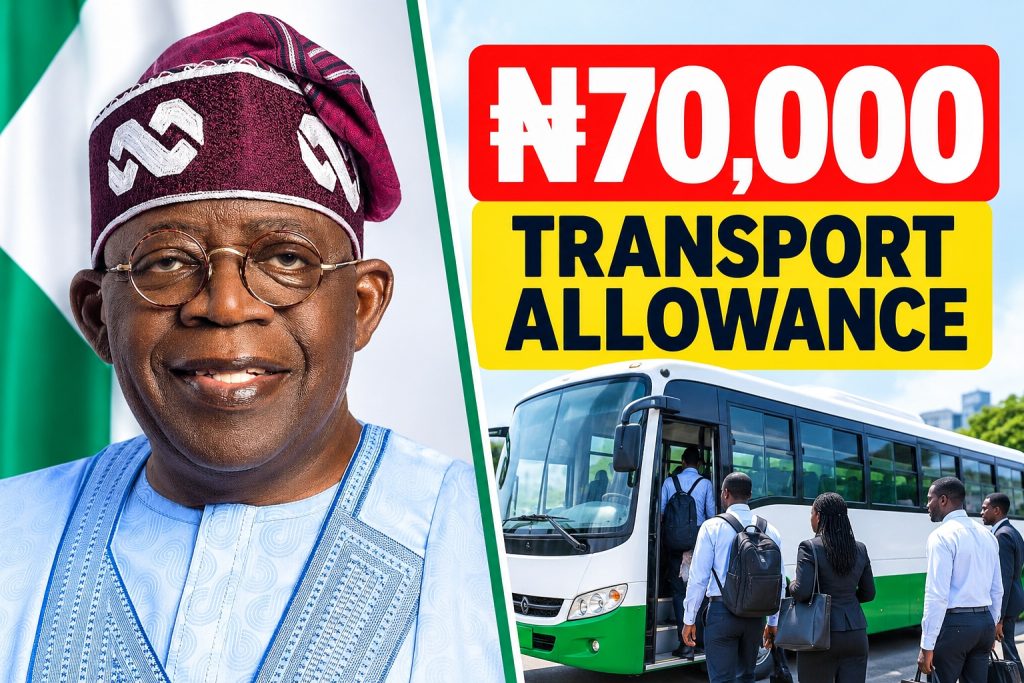
The Nigeria N70000 Worker Transport Allowance is a temporary support payment approved by the Federal Government to help public service workers cope with transport costs. Under an agreement with the Nigeria Labour Congress (NLC) on October 27, 2026, eligible workers will receive ₦70,000 monthly for six months, starting in November 2026. That is ₦420,000 in total if all six payments are made.
Join Our Channel
Not everyone has welcomed it. The Trade Union Congress (TUC) rejected the offer on October 28. No specific payment date has been confirmed yet.
Quick Facts: Nigeria N70000 Worker Transport Allowance
| Detail | Status (as of October 29, 2026) |
|---|---|
| Amount | ₦70,000 per month |
| Duration | Six months |
| Start month | November 2026 |
| Total value | ₦420,000 |
| Agreed with | Nigeria Labour Congress (NLC) |
| TUC position | Rejected on October 28 |
| Exact payment date | Not yet confirmed |
| Application portal | None announced |
In this guide you’ll find:
What Is Transport Allowance in Nigeria?
Transport allowance is a regular payment on top of basic salary to help cover the cost of getting to work, and it usually forms part of your gross salary. The Federal Government’s new ₦70,000 monthly allowance follows the same purpose, but it is a temporary six-month payment, not a permanent salary component.
How does this relate to the ₦70,000 allowance? A standard transport allowance is a permanent part of your pay package, set by your contract. The ₦70,000 allowance is a temporary six-month intervention starting in November 2026. It tackles the same cost, but it is not calculated from your salary and does not replace what your employer already pays you.
Latest News on the Nigeria N70000 Worker Transport Allowance
The NLC accepted the six-month transport allowance as part of its October 27 agreement with the Federal Government. The TUC, led by Festus Osifo, rejected it the next day. It argues that workers need a permanent salary increase, not a temporary allowance.
This means the deal should not be presented as unanimous acceptance by organised labour.
What TUC Is Demanding
- ₦300,000 minimum salary: The TUC wants the lowest-paid federal worker’s monthly pay raised from ₦70,000 to ₦300,000, with matching adjustments at other levels.
- Lower petrol prices: The NLC and TUC want prices brought back to 2024 levels.
- A new national minimum wage: The NLC says inflation has eroded the value of the current ₦70,000 minimum wage.
- Outstanding allowances: Labour wants unpaid wage-award and peculiar-allowance commitments honoured.
- Health sector agreements: The TUC wants outstanding Joint Health Sector Unions (JOHESU) agreements implemented, including the salary-structure adjustment.
- Relief from living costs: Labour wants lower prices for essential goods and timely payment of salaries and pensions.
Who Is Eligible for the Nigeria N70000 Worker Transport Allowance?
Is the N70K allowance for federal workers only, or state workers too? The agreement is between the Federal Government and the NLC, so federal workers are the direct beneficiaries. State and local governments have been urged to join, but they have not been confirmed as participating. Whether state and local government workers receive the allowance depends on whether their own governments adopt it. Check with your payroll office or union.
Do private-sector workers qualify for the Nigeria N70000 Worker Transport Allowance? No. The agreement is between the Federal Government and organised labour for public service workers, and nothing in it makes private employers pay the allowance. If you work in the private sector, check your employment contract and ask your employer or union whether any transport support applies to you.
When Will the Nigeria N70000 Worker Transport Allowance Be Paid?
Payments are due to begin in November 2026. However, the agreement gives no specific first-payment date. It also does not say whether the money will come as a separate payment or through existing payroll.
Watch for announcements from your payroll or HR department, the relevant civil service authority and your labour union.
Is the Transport Allowance the Same as the ₦70,000 Minimum Wage?
No. The two are separate.
- National minimum wage: The statutory minimum monthly pay under the National Minimum Wage Act, currently ₦70,000.
- Transport allowance: A temporary six-month support measure agreed between the Federal Government and the NLC. It is not a permanent increase in basic salary.
The October 27 meeting did not settle the effective date for the new minimum wage. Both sides agreed to set up a Minimum Wage Negotiation Committee and begin talks immediately (Punch Newspapers).
Other Allowances Approved at the Same Meeting
- Peculiar allowance arrears: Arrears effective from May 1, 2026 will be paid in three equal monthly instalments from November. The amount per worker has not been specified.
- Health workers’ arrears: 19 months of arrears will be settled within three months, starting December 2026.
- Agricultural workers’ hazard allowances: The beneficiary list and costs have been submitted for verification, with an implementation template to follow.
- Health salary structure: The National Salaries, Incomes and Wages Commission will update the cost assessment for the proposed CONHESS adjustment.
- Tax relief: Referred to the National Executive Council.
Approval of the transport allowance does not mean these other benefits have been paid.
How to Confirm Your Payment
- Contact your payroll or HR department.
- Check circulars from the relevant civil service authority.
- Follow announcements from your recognised labour union.
- Confirm whether your employer has issued implementation instructions.
Beware of scams: No public application portal has been announced, so you should not need to register online. Avoid any website or individual asking for a fee to release the allowance.
What Happens Next?
The Federal Government and the NLC agreed to reconvene after one month to review implementation. Labour unions are expected to push state and local governments to join. The key developments to watch are confirmation of the first payment, clarity on how it will be disbursed, and proof that the money is reaching workers.
How Transport Allowance Is Calculated in Nigeria
1. Percentage of Gross or Basic Salary
Many private employers set transport at roughly 10% to 15% of gross or basic pay. This is a common practice, not a legal requirement.
Formula: Transport allowance = Salary base (gross or basic) × agreed percentage
Example: The gross monthly salary is ₦200,000 and the company pays 10% as transport.
₦200,000 × 10% = ₦20,000 per month (₦240,000 per year)
Check whether your contract applies the percentage to gross or to basic pay. The same percentage gives very different amounts.
| Salary base | Monthly amount | 10% transport |
|---|---|---|
| Gross: ₦200,000 | ₦200,000 | ₦20,000 |
| Basic: ₦100,000 | ₦100,000 | ₦10,000 |
2. Fixed Flat Rate
Some employers pay the same amount to everyone, regardless of grade. Your contract or the company’s HR policy states the amount.
A current example is the Nigeria N70000 Worker Transport Allowance, a temporary ₦70,000 monthly payment for six months from November 2026, agreed between the Federal Government and the NLC. It is a fixed intervention, not a percentage of anyone’s salary, and it is separate from the national minimum wage.
3. Distance-Based Reimbursement
Staff who travel or work in the field may receive transport or duty-tour payments based on distance or actual trips. The rates depend on the employer’s policy or the applicable public service circular. Confirm any published per-kilometre rates against an official source.
How Transport Allowance Affects Pension
Pension contributions are calculated on basic salary + housing + transport (often called BHT). They are not calculated on your full gross. Under the Pension Reform Act, the employee contributes at least 8% and the employer at least 10%.
Example:
- Basic: ₦100,000
- Housing: ₦40,000
- Transport: ₦20,000
- BHT total: ₦160,000
Employee contribution: ₦160,000 × 8% = ₦12,800
Employer contribution: ₦160,000 × 10% = ₦16,000
A higher transport allowance therefore raises both pension contributions, even though other allowances do not.
How Transport Allowance Affects PAYE in 2027
Transport allowance counts as part of your gross employment income. Since January 1, 2026, the Nigeria Tax Act 2025 has replaced the old Personal Income Tax Act. The Consolidated Relief Allowance has been abolished and a wider zero-rate band introduced.
Annual PAYE Bands (Nigeria Tax Act 2025)
| Portion of taxable income | Rate |
|---|---|
| First ₦800,000 | 0% |
| Next ₦2,200,000 | 15% |
| Next ₦9,000,000 | 18% |
| Next ₦13,000,000 | 21% |
| Next ₦25,000,000 | 23% |
| Above ₦50,000,000 | 25% |
Step-by-Step PAYE Calculation
- Add up your annual gross (basic + housing + transport + other allowances).
- Subtract allowable deductions, such as pension, NHF and other eligible reliefs, to get your taxable income.
- Apply the bands progressively to that figure.
- Divide the annual tax by 12 to get your monthly PAYE.
Worked Example
A payroll practitioner’s illustration uses a monthly gross of ₦100,000: basic ₦35,000, housing ₦20,000, transport ₦15,000 and other allowances ₦30,000.
- Annual gross: ₦1,200,000
- Taxable income after deductions: ₦1,022,300
- Taxed at 0% on the first ₦800,000, then 15% on the remaining ₦222,300
- Annual PAYE: ₦33,345 (about ₦2,779 a month)
Your own figures will differ depending on your deductions and reliefs.
Is Transport Allowance Taxable?
Treat it as part of taxable income unless your payroll team confirms otherwise. Some commentary says benefits previously treated as exempt, such as housing and transport allowances, may now be taxed, and different pay items can be treated differently. Confirm with your employer’s payroll team or your state internal revenue service.
Does the ₦70,000 Allowance Count for Tax and Pension?
The reports on the Federal Government’s temporary ₦70,000 allowance do not say whether it will be taxed or counted for pension. Wait for official guidance from your payroll department or civil service authority before assuming either way.
Tips for Checking Your Own Allowance
- Read the salary breakdown in your employment letter.
- Confirm whether transport is a percentage or a fixed amount, and what it is a percentage of.
- Check your payslip against the pension and PAYE steps above.
- Ask HR to explain any difference between your contract and your payslip.
Frequently Asked Questions about Nigeria N70000 Worker Transport Allowance
What is the Nigeria N70000 Worker Transport Allowance?
It is a temporary ₦70,000 monthly payment for six months, approved for public service workers to ease transport costs.
When does the Nigeria N70000 Worker Transport Allowance start?
It starts in November 2026. The exact payment date has not been confirmed.
How much will workers receive in total?
₦420,000 over six months, if all payments are made.
Did the TUC accept the allowance?
No. The TUC rejected it on October 28 and is demanding a ₦300,000 minimum salary for the lowest-paid federal worker.
Do private-sector workers qualify?
The agreement does not say so. Check with your employer or union.
Do I need to apply?
No application portal has been announced. Rely only on official payroll and union channels.
What percentage is transport allowance in Nigeria?
There is no legal rate. Many private employers use about 10% to 15% of gross or basic pay, but your contract decides.
Is transport allowance part of gross salary?
Yes. It is added to basic salary, housing and other allowances to get your gross pay.
Is transport allowance included in pension calculations?
Yes. Pension is calculated on basic, housing and transport.
Is transport allowance taxable in Nigeria?
It is generally treated as part of employment income for PAYE. Confirm the exact treatment with your payroll team.
Is the ₦70,000 transport allowance the same as the minimum wage?
No. The minimum wage is a statutory monthly floor. The ₦70,000 transport allowance is a temporary six-month support payment from November 2026.
Conclusion
The Nigeria N70000 Worker Transport Allowance is a temporary support measure approved under the October 27, 2026 agreement between the Federal Government and the NLC. It provides ₦70,000 a month for six months from November 2026, ₦420,000 in total if all payments are made.
Federal workers are the direct beneficiaries. State and local government workers should not assume they will be paid until their own governments confirm participation. Private-sector workers are not covered by the agreement, so they should check their employment contract and ask their employer or union.
The exact payment date and disbursement method have not been confirmed, and the TUC has rejected the offer in favour of a permanent salary increase. Follow official payroll, civil service and union announcements for updates, and don’t pay anyone to “release” the allowance, as no application portal has been announced.
Join Our Channel